
Short answer: Those dark spots and streaks are not dirt and they are not shingle damage. They are a living blue green algae called Gloeocapsa magma, and they come off with a low pressure soft wash that applies a cleaning solution, kills the growth, and rinses it away. Scrubbing does not work. Pressure washing wrecks the shingle. The right treatment removes the spots and stops them from spreading.
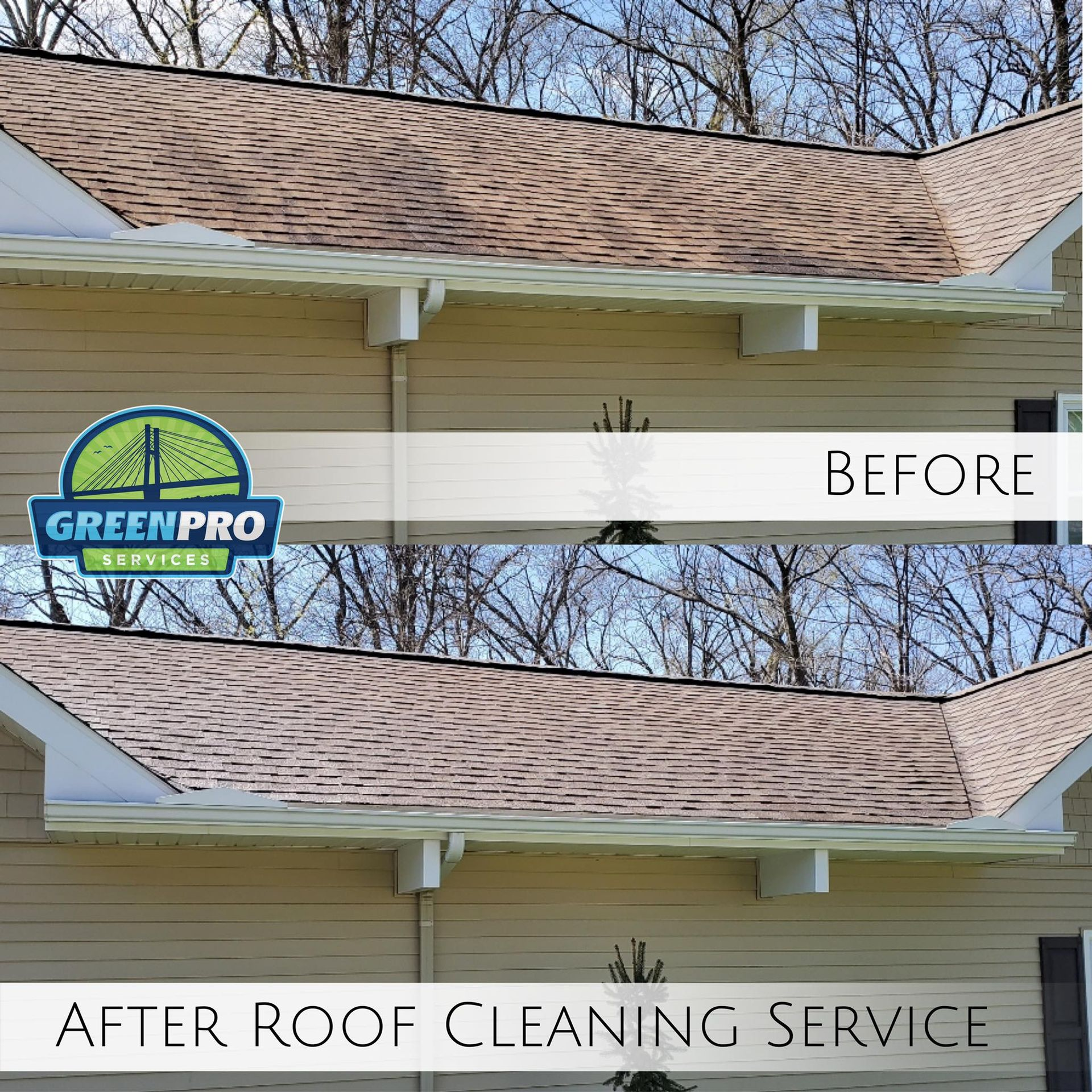
Before and after a soft wash roof cleaning on an asphalt shingle roof in Bourbonnais, IL.
Most people notice it from the driveway. One side of the roof looks fine and the other side looks stained, blotchy, or streaked with gray and black. Then the spots spread. A lot of homeowners around Kankakee and Will County assume the roof is wearing out and start pricing replacements. In most cases the shingles have plenty of life left and the problem sitting on top of them can be washed off in an afternoon.
Here is what those spots actually are, why they showed up on your house, and how they get removed for good.
Why Do I Have Dark Spots On My Roof?
You have dark spots because something is growing up there. Asphalt shingles are made with a limestone filler, and that filler is food for a hardy blue green algae called Gloeocapsa magma. Spores travel through the air, land on your roof, find moisture, and start feeding. The dark color comes from a protective outer coating the algae produces to shield itself from sunlight.
That is why the growth follows such a predictable pattern in northern Illinois. Look at your own roof and you will probably see it worst in these spots:
- North facing slopes, which hold moisture the longest because they get the least direct sun
- Sections shaded by mature trees, common in older Kankakee and Bourbonnais neighborhoods
- Below dormers, valleys, and anywhere water sheets slowly instead of draining fast
- Roof planes that sit under a second story wall and stay damp after rain
- The side facing a neighbor whose roof is already covered, since spores blow from house to house
Our climate does the rest. Humid summers, heavy spring rain, and long stretches of overcast weather give the growth exactly what it needs. It is not a sign you neglected the house. It is a sign your roof has been outside in Illinois for a few years.
What Are These Black Streaks On My Roof?
The vertical black streaks running down from the ridge are the same algae, spread by gravity. Rain washes spores and dead cells down the slope, so the colony grows downward in stripes instead of even patches. That is why streaking almost always starts at the top of the roof and works its way toward the gutter.
Three different organisms show up on roofs around here, and they do not all behave the same way:
- Algae looks like flat black or dark gray streaking. It stains the surface and feeds on the shingle filler.
- Moss is green, fuzzy, and thick. It lifts shingle edges and traps water underneath, which is the growth most likely to cause a leak.
- Lichen shows up as crusty gray or pale green circles that look painted on. It roots into the shingle surface and is the most stubborn of the three to remove.
One thing the streaks are not is a roof failure. Shingle damage looks different. It shows up as curling edges, bald patches where the granules are gone, cracked tabs, or a pile of granules in the bottom of your gutters. If you are seeing color and not texture, you are almost certainly looking at a cleaning problem.
How Do You Get Dark Spots Off A Roof?
You kill the organism with a cleaning solution and let it rinse away. You do not blast it off. That distinction is the whole job.
The method is called soft washing, and it is what the roofing industry recommends for algae removal. Here is how a professional roof cleaning actually runs:
- Inspect the roof. Pitch, shingle condition, and where the growth is heaviest all change the approach. A roof with soft or brittle shingles gets handled differently than a five year old roof.
- Protect the landscaping. Beds, shrubs, and every downspout outlet get soaked with plain water before anything is applied, so runoff lands heavily diluted.
- Apply the solution at low pressure. Roughly the pressure of a garden hose. The chemistry does the work, not the force.
- Give it dwell time. The solution needs several minutes on the surface to kill the algae all the way through, including the growth rooted into the granules.
- Rinse and flush. The roof gets rinsed, the gutters get flushed of everything that came down, and the landscaping gets soaked a second time.
Most of the change shows the same day. Then the roof keeps getting cleaner for two to three weeks as rain carries off the dead growth. Heavy moss and lichen release the slowest because they have to break down before they let go. That is normal and it is not a sign the treatment failed.
Do not pressure wash a roof. High pressure strips the granules that protect the asphalt from UV, takes years off the shingle, and voids most manufacturer warranties. It also drives water up under the shingle edges. A roof that looks clean for one season and fails early is an expensive way to save a few hundred dollars. We do not use high pressure on any roof, ever.
What Do Roofers Use To Clean Roofs?
The Asphalt Roofing Manufacturers Association points to a diluted sodium hypochlorite solution mixed with water for removing moss and algae from asphalt shingles. Professional cleaners use the same active ingredient, blended with a surfactant so the mix clings to a sloped surface long enough to work instead of running straight into the gutter.
What separates a professional application from a homeowner with a garden sprayer is control. Dilution gets matched to how heavy the growth is. Dwell time gets watched. Landscaping gets saturated before and after. Equipment applies the mix from a ladder or from the ground, which keeps weight and foot traffic off the shingles.
A few things you will see recommended online that are worth skipping. Vinegar and baking soda mixes do not kill the algae at the root, so the spots come back within weeks. Wire brushing tears granules off. And any product marketed as a one step roof cleaner that you spray and walk away from usually just lightens the stain without killing what caused it.
The bigger issue is the ladder. Roof work causes serious falls every year, and a wet roof is far more slippery than a dry one. Our crew completed OSHA 1910 safety training before ever setting a ladder on a customer's house. That is not a small detail when the alternative is standing on a wet slope on a Saturday morning.
How Do You Fix A Discolored Roof?
First figure out which kind of discoloration you have, because two of them clean off and one of them does not.
- Organic staining from algae, moss, or lichen cleans off completely with a soft wash. This is what most homeowners are looking at.
- Rust staining from well water hitting the roof, or from metal flashing and vents bleeding down the slope, needs a different chemistry than algae. It also cleans off, but not with the same product.
- Granule loss is not a stain. When granules wear away, the darker asphalt underneath shows through in patches. Nothing washes that back. That roof is aging and eventually needs replacement.
The quickest way to tell the difference from the ground is to look at the pattern. Organic growth is blotchy and streaky and concentrated on the shaded slopes. Granule loss looks worn and even, spread across the whole roof plane, and usually comes with a gutter full of gritty black sand.
Once the roof is clean, you can slow the regrowth down. Zinc or copper strips installed near the ridge release trace metal ions when it rains, and algae will not grow well where those ions run. Trimming back branches that shade the roof helps more than most people expect, because the growth needs damp shade to take hold. Keeping the gutters clear matters too, since a backed up gutter keeps the bottom edge of the roof wet.
Plan on cleaning every three to five years for most homes in this area. Heavily shaded roofs and north slopes often need it sooner.
Why Bother Cleaning It At All?
Curb appeal is the reason most people call. It is not the only one.
- Shingle life. Algae eats the limestone filler and moss holds moisture against the shingle. Removing the growth stops the damage instead of waiting for a replacement quote.
- Cooling cost. Dark streaking absorbs heat that light shingles were designed to reflect. Your attic and your air conditioner both notice it in July.
- Resale. A streaked roof reads as a worn out roof to buyers, appraisers, and home inspectors. Cleaning it is one of the cheapest moves before listing photos.
- Cost. A roof cleaning is a small fraction of a roof replacement, and it buys the existing roof more years.
Most people who book a roof cleaning add a house washing at the same time, because the siding under a streaked roof usually has algae on it too. If the whole exterior needs attention, our full service list covers the rest, and the Green Pro Clean Club puts it on a schedule so the growth never gets a chance to come back this far.
You can also see the work itself. We wrote up a day of roof washing and gutter cleaning across Clifton, Bourbonnais, and Kankakee, with before and after shots from each stop.
Where We Clean Roofs
Green Pro Services cleans roofs across Kankakee County, Will County, and the south suburbs of Cook County. That includes Bourbonnais, Bradley, Manteno, Frankfort, New Lenox, Mokena, Monee and Crete, Orland Park, and Olympia Fields.
We measure most properties from satellite imagery, so a roof quote usually does not require a site visit or an appointment. Send us the address and we come back with a written price.
Common Questions
Dark Spots On Roofs, Answered
They are living. The dark spots and streaks on asphalt shingles are almost always Gloeocapsa magma, a blue green algae that feeds on the limestone filler in the shingle. Dirt rinses off with rain. This does not, because it keeps growing back from what is still alive on the surface.
Eventually, because new spores keep landing on the roof. A proper soft wash kills what is there and buys three to five years for most homes in Kankakee and Will County. Shaded roofs regrow faster. Zinc or copper strips at the ridge and trimming back overhanging branches both stretch the time between cleanings.
It is possible and it is risky. The two problems are the ladder and the mix. Wet roofs cause serious falls, and getting the dilution wrong either does nothing or damages landscaping below the downspouts. If you try it, never use a pressure washer, saturate every plant before and after, and stay off the shingles.
Usually not. Streaking is growth sitting on top of the shingle, not shingle failure. What signals a failing roof is curling edges, cracked or missing tabs, bald spots where granules are gone, and gritty black sand collecting in the gutters. Many homeowners who thought they needed a replacement just needed a cleaning.
They help, and they work best as prevention rather than a cure. Rain running over the metal carries trace ions down the slope, and algae struggles to establish in that path. They will not clean an already stained roof and they only protect the area directly below them, so streaking can still appear around dormers and on slopes the runoff misses.
Price depends on roof size, pitch, how many stories, and whether you have moss and lichen along with algae. We measure the roof from satellite imagery and send a written price before anything is scheduled, so there is no site visit to sit through and no obligation. Booking a house washing or gutter cleaning in the same visit lowers the cost of both.
Get The Dark Spots Off Your Roof
Send us your address and we will measure the roof, look at the growth, and send a written price. No pressure and no obligation. Rated 5.0 stars across more than 100 Google reviews.
Locally owned exterior cleaning serving Kankakee County, Will County, and the south suburbs of Cook County, Illinois.
(815) 650-0397
407 S. Yates Ave, Kankakee, IL 60901
© 2026 Green Pro Services of Kankakee LLC. All rights reserved. · Privacy Policy · Terms of Service